2008
Falcon 1 becomes the first private rocket to reach orbit
On its fourth try, SpaceX's small Falcon 1 reached orbit, a first for a privately developed liquid-fueled rocket and a lifeline for a company low on cash.
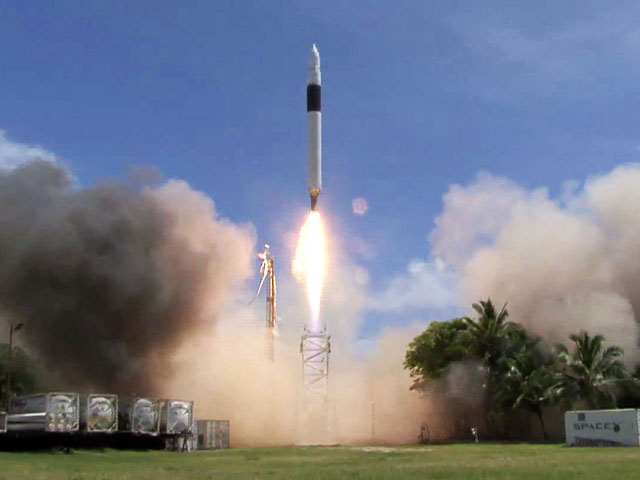
On September 28, 2008, at 23:15 UTC, a two-stage rocket called Falcon 1 lifted off from Omelek Island, a speck of land in the Kwajalein Atoll of the Marshall Islands. About nine and a half minutes later its second stage shut down in orbit. After a coast, the Kestrel engine fired again and settled the stage into an orbit roughly 620 to 640 kilometers above Earth. Riding along was a 165-kilogram dummy payload, a non-functional boilerplate built only to prove the rocket could do its job.
The flight came after three failures in a row. The first Falcon 1, in March 2006, crashed onto a reef less than a minute after launch when a corroded fuel-line nut gave way. The second, in March 2007, climbed to space but lost control as propellant sloshed in its tank. The third, in August 2008, carried real satellites, including payloads for the US Air Force and NASA, and failed when the spent first stage bumped into the second after separation. For the fourth attempt, the team assembled a rocket from available parts in six weeks. The vehicle was nearly lost on the way, when it partly collapsed during a cargo flight and needed emergency repairs. The only real design change was a longer pause between first-stage shutdown and separation.
Why it matters
Falcon 1 was the first privately developed, fully liquid-fueled rocket to reach orbit. Elon Musk later said that the fourth launch used the last money SpaceX had for the program, and that another failure would have ended the company. Instead, the success kept SpaceX alive at a moment when Musk was also short of funds for his other businesses and the global recession was starting.
Falcon 1 flew only once more, in July 2009, when it placed the Malaysian satellite RazakSAT in orbit on SpaceX’s first commercial launch. The company then retired the rocket, saying it could not make Falcon 1 work as a business, and moved on to the much larger Falcon 9. Many of Falcon 9’s components and structural ideas had first been tested on its small predecessor, including the Merlin engine family.
Did you know?
The entire development of Falcon 1 cost an estimated 90 to 100 million US dollars, and its second stage from the successful flight was still circling Earth more than a decade later.