1869
Mahatma Gandhi is born
The lawyer who turned nonviolent resistance into a mass political force, and led India's campaign for independence, is born in Porbandar.
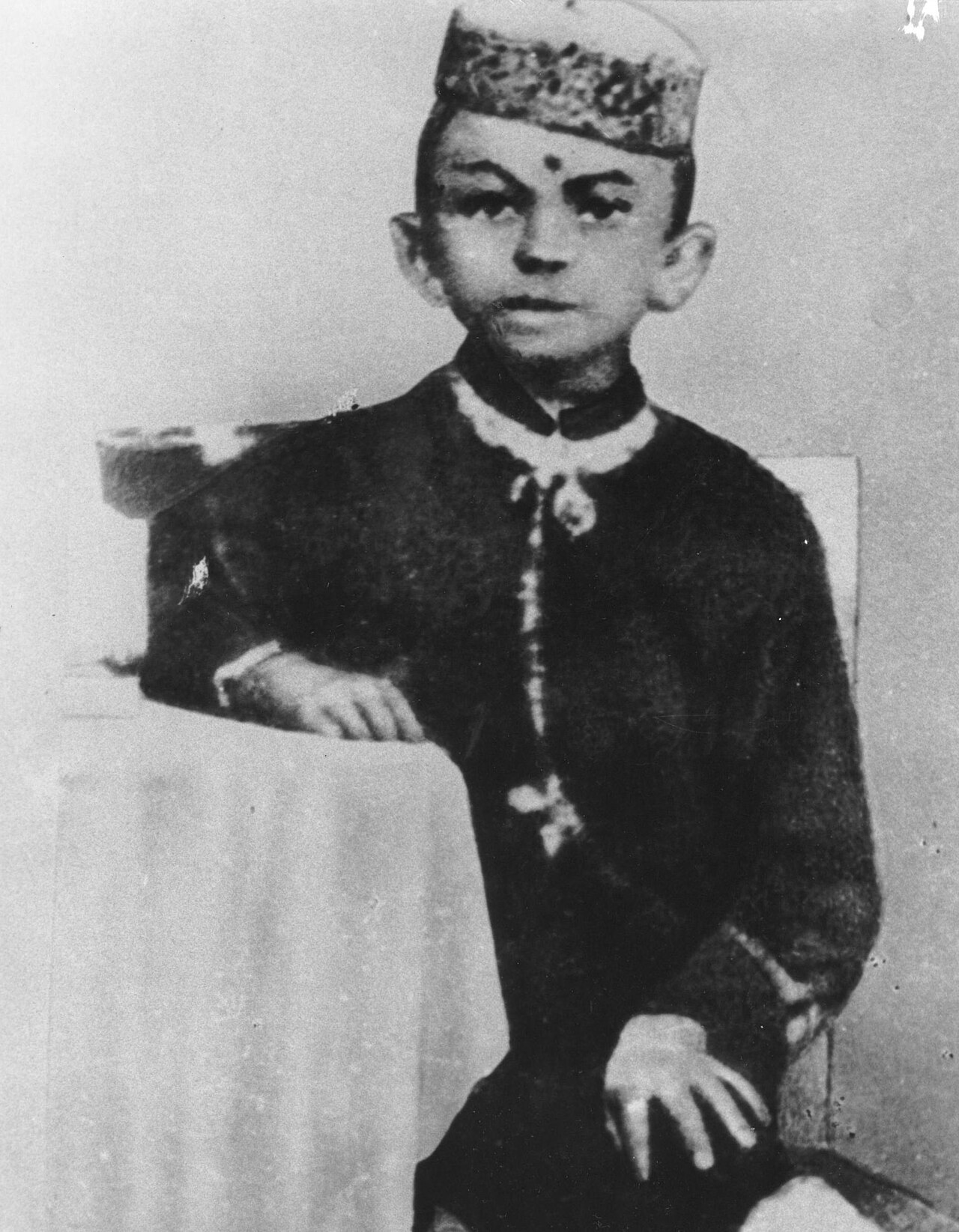
Mohandas Karamchand Gandhi was born on October 2, 1869, in Porbandar, a coastal town on the Kathiawar Peninsula in western India. Porbandar was then a small princely state under the British Raj, and his father, Karamchand Gandhi, served as its dewan, or chief minister. His mother, Putlibai, came from a deeply devout Vaishnava family and kept strict fasts and vows, habits that left a strong impression on her youngest child. Mohandas was the fourth of the couple’s children.
When he was a boy, the family moved to Rajkot, where his father took a similar post. Gandhi was a shy, average student who preferred books to games, and he was married at 13 to Kasturba, in an arranged marriage typical of the region at the time. As a young man he studied law in London and was called to the bar at 22. His attempts to practice in India failed, and in 1893 he accepted a job representing an Indian merchant in South Africa. He stayed for 21 years, raised a family there, and first used nonviolent resistance in campaigns for the civil rights of Indians.
Back in India from 1915, Gandhi organized peasants and workers, took the lead of the Indian National Congress in 1921, and adopted the simple hand-spun dhoti as a sign of solidarity with the rural poor. In 1930 he led the 400-kilometer Salt March against the British salt tax, and in 1942 he called on Britain to quit India. He was jailed many times. India won independence in August 1947, but partition brought terrible religious violence, which Gandhi tried to stop with hunger strikes. He was assassinated in Delhi on January 30, 1948.
Why it matters
Gandhi is regarded as the leading figure of India’s independence movement and is honored in India as the Father of the Nation, often called Bapu, an affectionate word for father. He did not invent nonviolence, a principle with a long history in Indian religious thought, but he was the first to apply it as a political method on a large scale. His idea of satyagraha, resistance through moral rather than physical force, influenced later movements for civil rights and freedom around the world.
His birthday is still marked each year. In India, October 2 is Gandhi Jayanti, a national holiday, and around the world it is observed as the International Day of Nonviolence.
Did you know?
The title “Mahatma”, Sanskrit for “great-souled”, was first applied to Gandhi in 1914, while he was still living in South Africa.