1982
The first CD player goes on sale
Sony launched the CDP-101 in Japan, the first compact disc player sold to the public, and opened the digital era of recorded music.
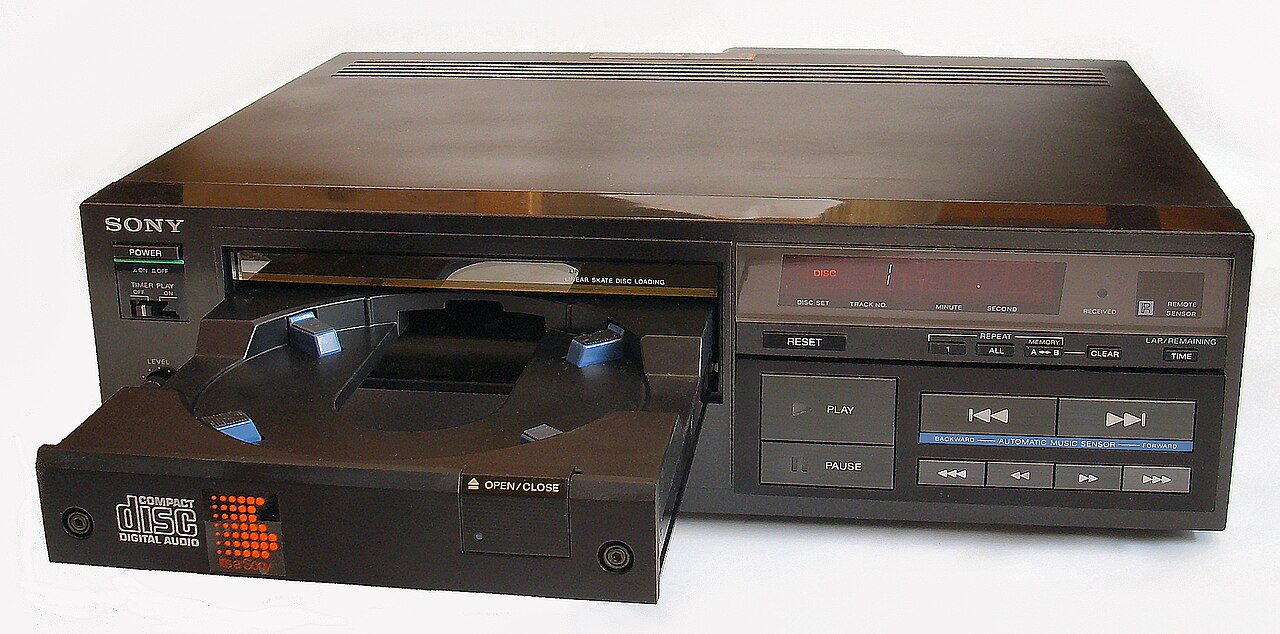
On October 1, 1982, Sony put the CDP-101 on sale in Japan. It was the first compact disc player ever released commercially, and its list price was 168,000 yen, about 730 US dollars at the time. Buyers could play a new kind of record: a small, shiny disc read by a laser, storing music as digital data.
The compact disc was a joint project of Sony and Philips, and the two companies had agreed on a launch date. Philips could not meet it, so instead of postponing everything, Sony agreed to hold off on sales outside Japan for six months. The Philips CD100 reached the United States and Europe in March 1983, the same month the format launched worldwide, and even some early Philips players contained Sony parts.
The CDP-101 looked different from the prototypes Sony had shown off. Demonstration models held the disc upright behind a clear front so that people could watch it spin, but the production machine used a horizontal tray that slid out to take the disc. The front panel had a fluorescent display for track numbers and playing time, a sensor for the included remote control, and a single dial, which set the volume of the headphone jack. Inside was a 16-bit digital-to-analog converter designed and built by Sony. Converters were so expensive at the time that one chip served both stereo channels, leaving the left and right signals out of step by about 11 microseconds.
Why it matters
The CDP-101 opened the market for a format that became the dominant way to buy recorded music. By 1991 the CD had outsold vinyl records and cassette tapes in the United States, and by 2000 it accounted for more than 92 percent of the country’s music market. The same discs were adapted to store computer data as the CD-ROM, and by 2007 more than 200 billion CDs of all kinds had been sold worldwide. The rise of MP3 files, downloads, and streaming in the mid-2000s brought its decline.
The player’s 16-bit converter reflected a fight over the standard itself. Sony insisted on 16-bit encoding for the compact disc, partly because Philips already had a 14-bit converter and Sony feared its partner would reach the market first.
Did you know?
The model name was chosen by Nobuyuki Idei, head of Sony’s audio division. In binary, 101 means five, and Idei picked it because he considered the player a medium-class model.