1949
Mao proclaims the People's Republic of China
From the Tiananmen Gate in Beijing, Mao Zedong announced a new government, ending decades of civil war and founding the state that still rules mainland China.
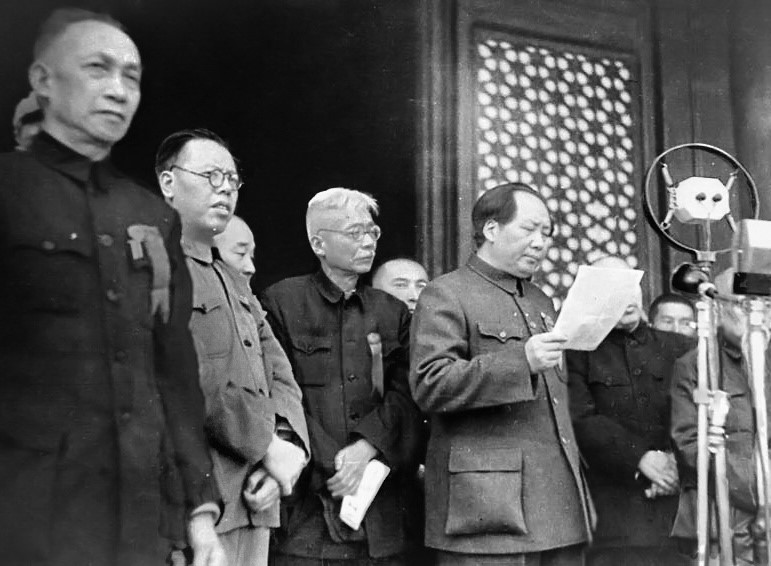
At three o’clock in the afternoon on October 1, 1949, Mao Zedong stood atop the Tiananmen Gate in Beijing and told a vast crowd in the square below that the Central People’s Government of the People’s Republic of China had been established that day. The chairman of the Chinese Communist Party then read a longer declaration naming the new leadership: Mao as chairman, six vice chairmen including Zhu De, Liu Shaoqi, and Song Qingling, and Zhou Enlai as premier and foreign minister. Beijing was named the capital.
The ceremony was full of firsts. “March of the Volunteers” was played as the national anthem, and the Five-starred Red Flag was raised for the first time while a 21-gun salute sounded in the distance. A military parade followed, with about 16,000 soldiers of the People’s Liberation Army marching past. Commanded by Nie Rongzhen and inspected by Zhu De, it was the first large public review of troops in modern Chinese history, organized in a format modeled on the parades of Moscow’s Red Square.
The day closed a long struggle. Since 1927 the Communists had fought the Nationalist government of the Kuomintang, with a pause during the war against Japan. By 1949 the Communists held most of the mainland. Mao had already announced the new state on September 21 at the first session of the Chinese People’s Political Consultative Conference, and the name itself came out of debate: Mao first considered keeping “Republic of China,” but critics urged a clean break, and the committee chose “People’s Republic of China” instead.
Why it matters
The proclamation created the state that has governed mainland China ever since, with the Communist Party as its sole ruling party. The Soviet Union recognized the new government the next day, and other communist states soon followed, while the United States and many Western countries continued to recognize the Nationalist government. That government retreated to Taiwan by December 1949.
The split left a question that remains open. Both the People’s Republic and the Republic of China on Taiwan have officially claimed to be the legitimate government of all China, and no armistice or peace treaty ever formally ended the civil war. October 1 became the country’s National Day, the anniversary of the afternoon when a new flag first rose over Tiananmen Square.
Did you know?
The proclamation of 1949 was not the Communist Party’s first attempt at a state. In 1931 it declared a Chinese Soviet Republic in Ruijin, which lasted until 1937.