1957
The Soviet Union launches Sputnik
A small polished sphere sent its beeping signal around the globe, became the first artificial satellite, and set off the Space Race.
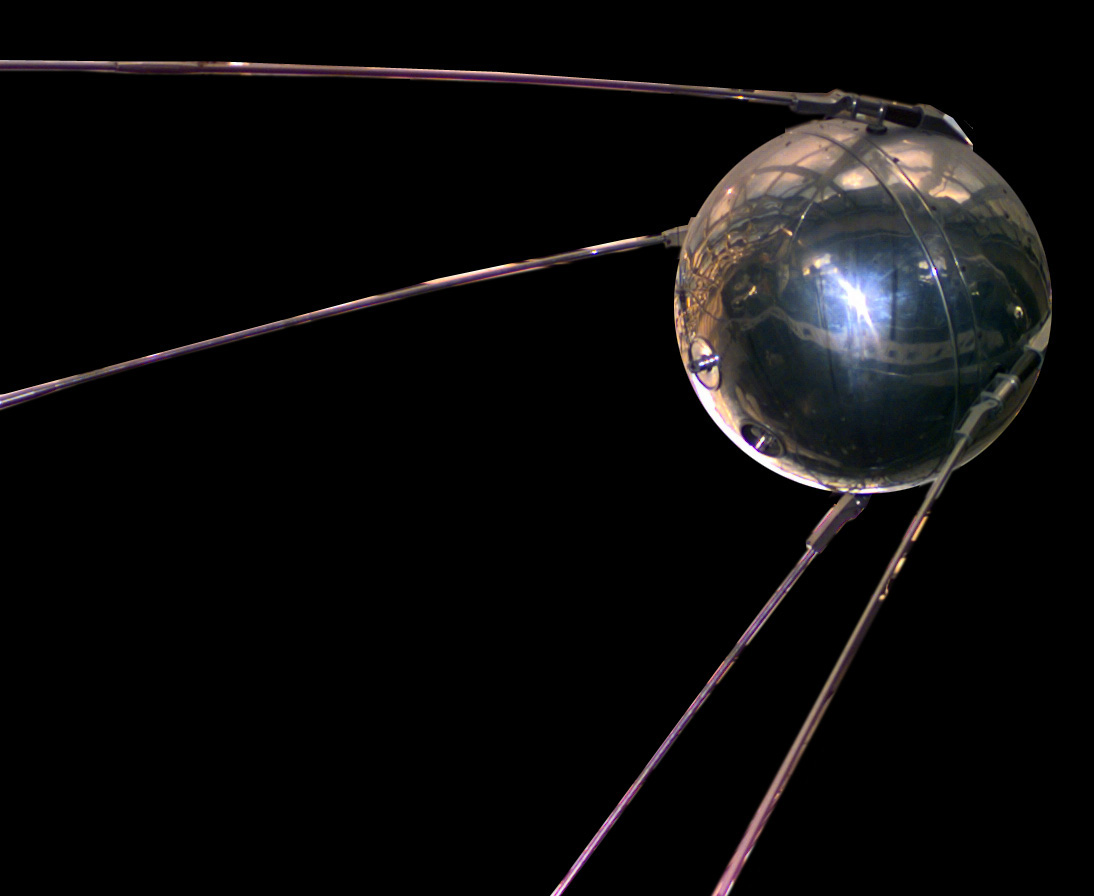
On October 4, 1957, at 19:28 UTC, a modified R-7 rocket lifted off from the Tyuratam range in the Kazakh Soviet Republic, the site later known as the Baikonur Cosmodrome. At the launch site it was already October 5. About five minutes later the satellite separated from the rocket and switched on its radio, and a tracking station picked up the “beep-beep-beep” that confirmed it was in orbit. The launch team waited roughly 90 minutes, until the satellite had completed a full circuit of the planet, before chief designer Sergei Korolev telephoned Soviet leader Nikita Khrushchev.
The satellite itself was deliberately simple. The Soviet program had first planned a heavy scientific spacecraft, but delays pushed it back, and fearing that the United States would get there first, engineers proposed a light, quick alternative. The result was a polished metal sphere 58 centimeters across, weighing 83.6 kilograms, with four whip antennas. It carried little more than a radio transmitter and batteries. The R-7 that lifted it had been designed as an intercontinental ballistic missile.
Sputnik circled the Earth every 96.2 minutes on a path that crossed almost every inhabited region. Amateur radio operators around the world tuned in to its signal, and observers scanned the sky at dawn and dusk. The transmitter fell silent on October 26, when the batteries ran out. The satellite stayed in orbit until January 4, 1958, when it burned up in the atmosphere after 1,440 orbits.
Why it matters
Sputnik opened the Space Age and shocked the American public, which had seen the United States as the clear technological leader. The televised explosion of a Vanguard rocket in December 1957 deepened the dismay. The United States answered by creating the Advanced Research Projects Agency, later DARPA, and NASA, and by passing the National Defense Education Act of 1958, which funded loans for students of science and mathematics. Explorer 1, the first American satellite, reached orbit on January 31, 1958.
The flight also had scientific value. Tracking how the atmosphere slowed the sphere revealed the density of the upper air, and the behavior of its radio signals gave data on the ionosphere.
Did you know?
Most people who thought they saw Sputnik in the night sky were looking at the 26-meter core stage of its rocket, which also reached orbit and was far brighter than the small satellite.