1952
The UK becomes the third nuclear power
Britain detonated its first atomic bomb inside a warship off Western Australia, joining the United States and the Soviet Union as a nuclear power.
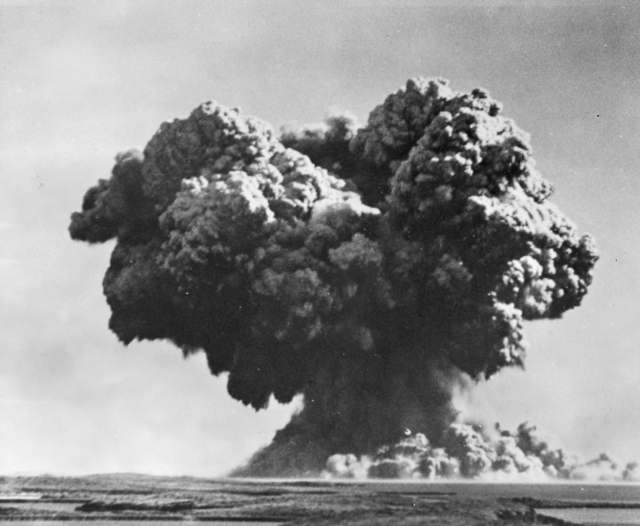
At 7:59 in the morning, local time, on October 3, 1952, a British plutonium implosion device exploded in the Montebello Islands, a remote and uninhabited group off the coast of Western Australia. The test, code-named Operation Hurricane, made the United Kingdom the third country to possess atomic weapons, after the United States and the Soviet Union.
Britain had worked on the bomb during the Second World War, but its project was merged into the American Manhattan Project, and after the war the United States cut off cooperation. In January 1947 a small cabinet committee decided that Britain would build its own weapon, under a program called High Explosive Research, with the physicist William Penney in charge of the design. A test site was the next problem. The Americans turned down a request to use their Pacific proving grounds, so the British government asked Australia, and Prime Minister Robert Menzies agreed in 1951 to the use of the Montebello Islands.
A fleet of Royal Navy ships, joined by 11 vessels of the Royal Australian Navy, gathered at the islands. To learn what a bomb smuggled into a harbor aboard a ship could do, the device was placed inside the hull of the frigate HMS Plym, anchored about 350 meters off Trimouille Island. The explosion, with an estimated yield of 25 kilotons, vaporized most of the ship and gouged a crater in the seabed 300 meters across. The bomb performed exactly as its designers had predicted.
Why it matters
Operation Hurricane gave Britain a seat at the nuclear table and a path to its own deterrent. The first production bombs, a design called Blue Danube based on the Hurricane device, reached the Royal Air Force in November 1953. Yet the test did not win back the close nuclear partnership with Washington that London wanted. Four weeks later the United States demonstrated a hydrogen bomb, and the American Congress saw little to gain from sharing secrets with a country that had only mastered older technology.
The test also left a mark on Australia. Radioactive contamination of the islands was severe, the fallout cloud eventually drifted over the mainland, and the area stayed off-limits until 1992. Further British tests followed in the Montebellos in 1956, and the site is now part of a park where visitors are advised to limit their time.
Did you know?
When a survey party went to check the Montebello Islands in late 1950, the Admiralty’s charts of the area were more than a century old: they had been drawn by HMS Beagle in August 1840.