1937
The last Bali tiger is killed
Hunters in western Bali shot what is often recorded as the island's last confirmed tiger, a female, ending a population hunted for sport for decades.
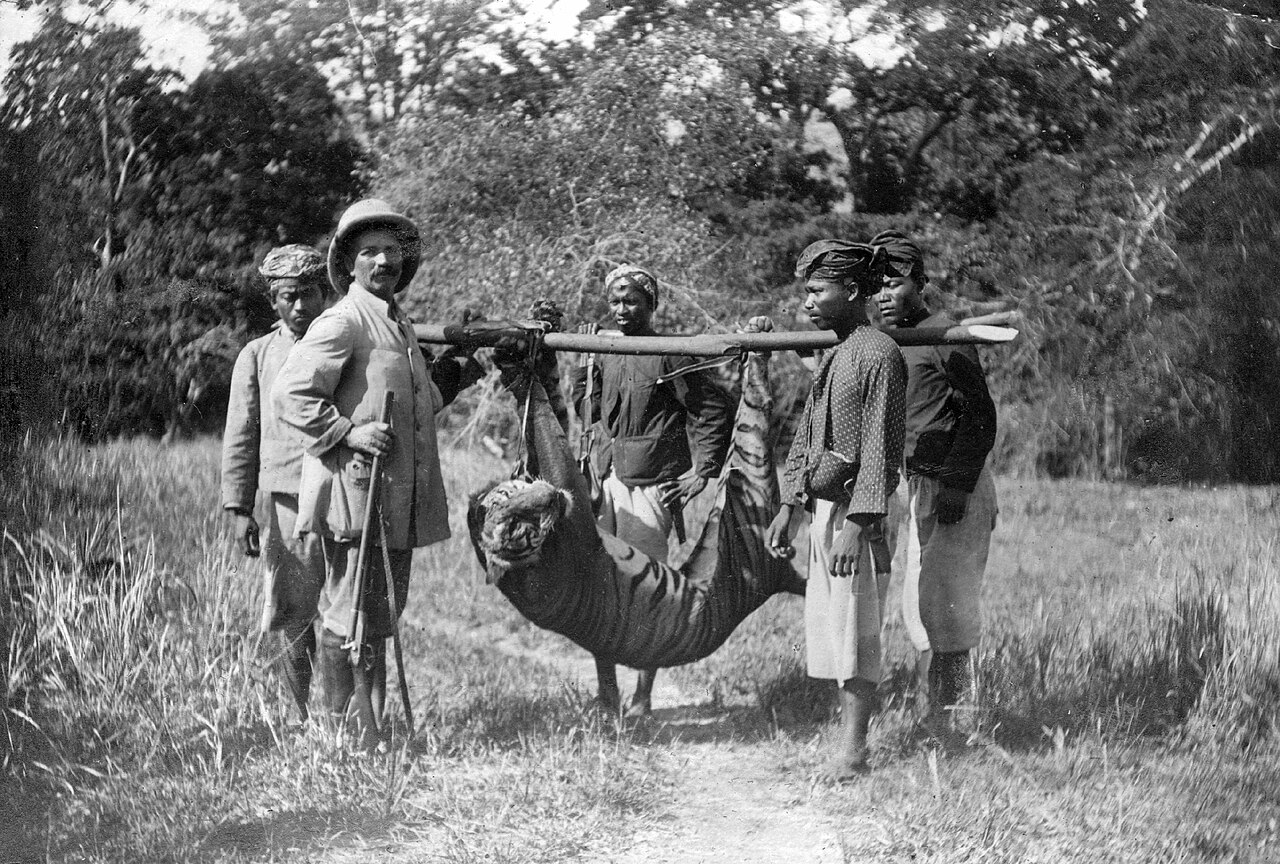
The tigers of Bali were the smallest in the Sunda Islands. Males weighed around 90 to 100 kilograms and females 65 to 80 kilograms. Most known specimens came from the west of the island, a landscape of mangroves, dunes, and savanna where the cats probably hunted Javan rusa deer. Balinese people called the animal harimau Bali or samong, and it held a place in local folklore, magic, and painting.
By the late 19th century, the island was changing fast. Palm plantations and irrigated rice fields spread across the fertile volcanic slopes in the north and the lowlands near the coast. In time, the tigers survived mainly in the west. After the Dutch took control of Bali, European sportsmen began arriving from Java with high-powered rifles. A favorite method was a heavy steel trap hidden under live bait, such as a goat, followed by a shot at close range. One gunmaker from Surabaya alone is said to have killed more than 20 tigers in a few years.
The last tigers on Bali were recorded in the late 1930s. A female shot in western Bali on September 27, 1937, is often cited as the final confirmed animal. A few individuals may have hung on into the 1940s or even the 1950s, but no specimen ever reached a museum after the Second World War. In 1941, the island’s first game reserve was set up in western Bali, the forerunner of West Bali National Park, but it came too late to save the population.
Why it matters
The Bali tiger is a stark example of a large predator wiped out in modern times by hunting and the loss of its habitat. The IUCN assessed it as extinct in 2008. In 2017, scientists revised tiger taxonomy and grouped the Bali tigers with the extinct Javan tigers and the surviving Sumatran tigers as a single subspecies, Panthera tigris sondaica. As a result, the Bali tiger is classified as a lost island population rather than a separate kind of tiger, but its disappearance from Bali is just as final.
Only a handful of skins and skulls survive. The British Museum in London holds the largest collection, and the Zoological Museum of Bogor in Indonesia keeps the remains of the last known Bali tiger.
Did you know?
Balinese tradition held that powdered tiger whiskers made a deadly, undetectable poison, while babies wore protective necklaces that included a tiger’s tooth or a piece of tiger bone.