1789
Parisian women march on Versailles
Market women angry over bread prices led thousands from Paris to the royal palace and forced Louis XVI to return with them to the capital.
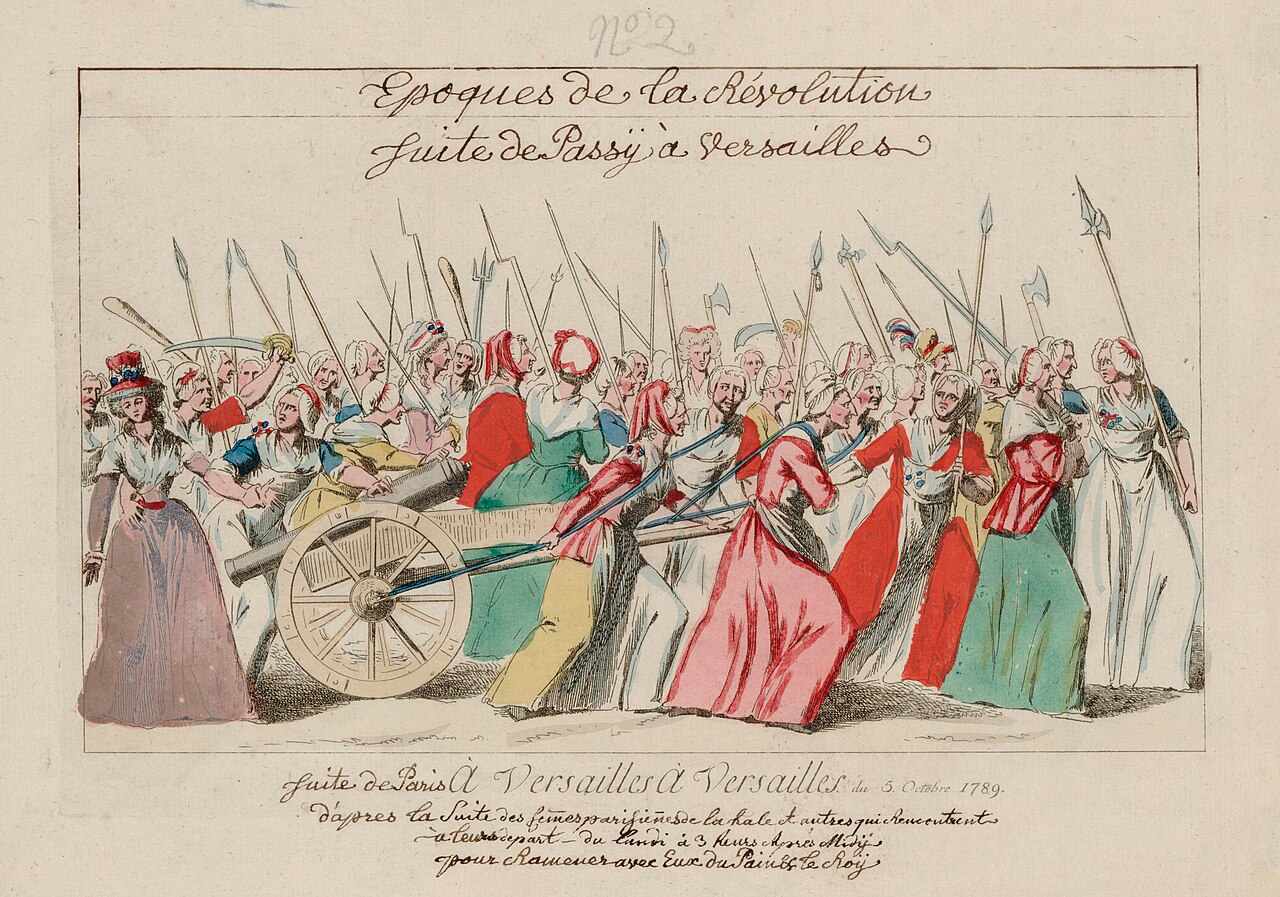
On the morning of October 5, 1789, a young woman beat a drum in a Paris marketplace, and a crowd of market women angry at the scarcity and price of bread began to gather. Less than three months had passed since the fall of the Bastille, and many poor Parisians spent nearly half of what they earned on bread. Rumors of plots to starve the poor were everywhere. Fresh anger came from reports of a lavish banquet at Versailles a few days earlier, where royal officers were said to have trampled the revolutionary tricolor cockade.
The women forced church bells to ring and marched on the Hôtel de Ville, the city hall, demanding bread and weapons. By then the crowd numbered six to seven thousand, perhaps more. Stanislas-Marie Maillard, a hero of the Bastille, took the lead and steered them toward Versailles, about 21 kilometers away, through heavy rain. They dragged cannons taken from the city hall. That afternoon some 15,000 National Guardsmen followed, with the Marquis de Lafayette reluctantly at their head.
At Versailles the marchers poured into the National Assembly. Six women met King Louis XVI, who promised food, and that evening he agreed to accept the August Decrees and the Declaration of the Rights of Man in full. Many in the crowd stayed. Early on October 6 protesters broke into the palace, killed guards, and nearly reached Queen Marie Antoinette, who fled with her ladies to the king’s bedchamber. Lafayette calmed the scene, and the royal family was escorted to Paris that afternoon in a procession of more than 60,000 people.
Why it matters
The march came months after the Revolution began, but it changed its course. The king lost his independence: from then on he lived in the Tuileries Palace under the eyes of the Parisian public, and within two weeks the Assembly moved to the capital too. Dozens of monarchist deputies stayed away, which weakened their faction. Maximilien Robespierre, who had spoken up for the women in the Assembly, gained a public profile that helped his later rise.
For the women of Paris, the march became a point of pride. They were celebrated on their return as “Mothers of the Nation” and courted by Paris governments for years afterward.
Did you know?
On reaching the run-down Tuileries, Louis XVI asked for a history of Charles I, the deposed king of England, to be brought from the library.