1773
Louis Philippe I is born
The future Citizen King is born in Paris. He would fight for the Revolution, live for years in exile, and become the last French ruler to be called king.
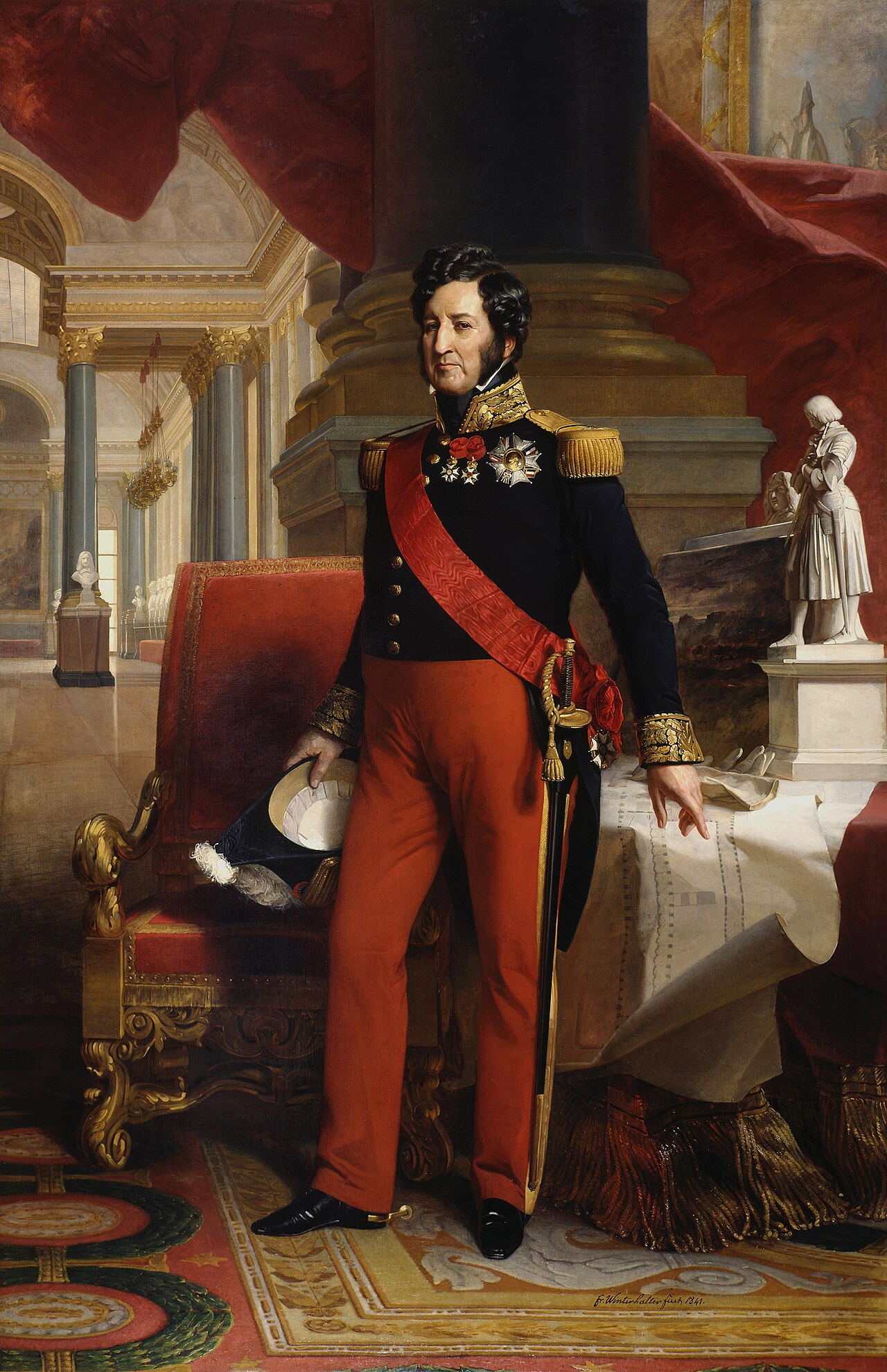
Louis Philippe was born on October 6, 1773, in the Palais-Royal, the Paris home of the Orléans family. He was the eldest son of Louis Philippe, Duke of Chartres, and Louise Marie Adélaïde de Bourbon, a very wealthy heiress. As a member of the cadet branch of the House of Bourbon, he was a prince of the blood, but the senior branch that held the throne distrusted his family, and his father was kept away from court.
His education took a liberal turn. From 1782 he was tutored by the Countess of Genlis, and when the Revolution came he joined the Jacobin Club with his father’s support. As a young officer he fought at Valmy and Jemappes in 1792 and became a lieutenant general before he turned 20. The execution of Louis XVI, which his father voted for, turned him against the Republic. Linked to General Dumouriez’s plot to march on Paris, he fled France in April 1793. His father, known as Philippe Égalité, was guillotined that November.
Exile lasted 21 years. Under a false name he taught geography, history, mathematics, and languages at a boys’ school in Switzerland. He traveled to Scandinavia and Lapland, spent about three years in the United States, where he met George Washington, and then settled in England.
Why it matters
In 1830 the July Revolution forced his cousin Charles X off the throne, and the Chamber of Deputies proclaimed Louis Philippe king. He took the title King of the French rather than King of France, tying the crown to the people instead of the land. Known at first as the Citizen King, he ruled without the pomp of his predecessors, yet his government came to favor wealthy bankers and industrialists while only a small, property-owning minority could vote. His reign, the July Monarchy, also saw friendship with Britain and the French conquest of Algeria.
Economic crisis in 1846 and 1847 eroded his support. During the Revolution of 1848 he abdicated on February 24 and escaped to England in disguise, traveling as “Mr. Smith.” The Second Republic followed, and no later French monarch held the title of king. He died in exile at Claremont, in Surrey, on August 26, 1850.
Did you know?
The Arc de Triomphe in Paris, which his government inaugurated in 1836, honors his own service in the Revolutionary Wars. His name is carved on its northern pillar as “Chartres,” the title he held as a young general.